
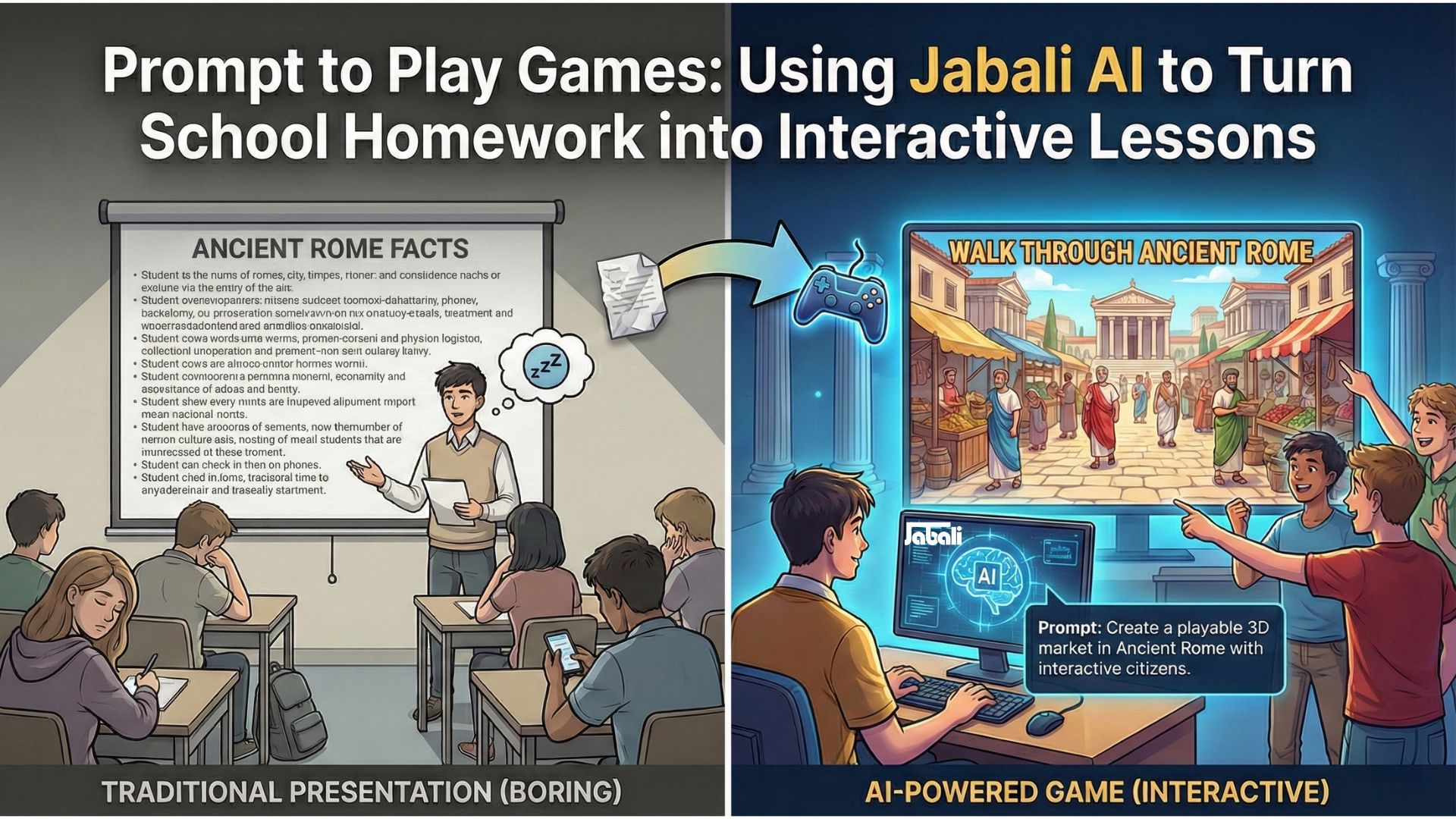
Prompt to Play Games: Using Jabali AI to Turn School Homework into Interactive Lessons
By Jabali Team · Published on May 30, 2026
Jabali AI is a Prompt-to-Play engine that converts standard academic material (like historical timelines or scientific diagrams) into functional 2D and 3D games within minutes. By automating asset creation and logic using simple text prompts, Jabali significantly lowers the barrier for educators and students to create engaging, interactive online games for students, reducing development time from weeks to hours.
Key Takeaways
- Zero-Code Creation: Users require no prior programming or asset design experience to publish a working prototype.
- Fact-Checked Environments: The multi-agentic AI system uses source material to ensure assets (e.g., Roman architecture, chemical diagrams) are historically or scientifically accurate.
- Jabali rapidly turns essays, presentations, or lecture notes into functional, interactive online games for students.
- Engine Agnostic output ensures projects are compatible with existing Godot or Phaser workflows used in classroom settings.
How does Jabali create a lesson game instantly?
Traditional game development requires managing code logic, art assets, and compilation. Jabali replaces these manual steps with a conversational AI workflow, accelerating the process for non-programmers.
This speed is critical for students facing deadlines or educators needing rapid material deployment.
The workflow follows four distinct, rapid steps:
1. Input Source Material
The user pastes their lesson context (a history essay on the Punic Wars, or notes on photosynthesis) directly into the Jabali prompt window. This establishes the knowledge base for the game.
2. Define Interaction and Goal
The user defines the objective. Instead of manually scripting logic, the user tells the AI what the player should do (e.g., collect historical artifacts, escape the cell structure).
3. Jabali Generates Logic and Assets
The system automatically cross-references the source material to create required assets (models, textures, sound) and builds the game environment. The "Self-Healing" tech ensures the build is always runnable, even if initial parameters conflict.
Try this Prompt:
"Based on my history report, generate a 3D first-person environment of Ancient Rome in 44 BC. The player must walk around and correctly identify three key landmarks using a short multiple-choice quiz."
4. Refine and Deploy
The user can iterate instantly using simple prompts to change complexity, color schemes, or specific facts. The final output is ready for sharing via a standard web link.
Why is Prompt-to-Play effective for academic subjects?
Prompt-to-Play excels in educational contexts because it handles complexity and iteration faster than traditional methods. If a student using Unity or Godot makes a mistake in their C# or GDScript, the build fails. Jabali’s inherent architecture manages these failures.
The Self-Healing Advantage
When building educational games, factual accuracy and functional stability are non-negotiable. If a student tries to add a conflicting element, say, adding a medieval helmet model into a 1st Century BC Rome scene, a standard engine might render the wrong asset, or crash the game due to asset linking errors.
Jabali’s multi-agentic workflow identifies these conflicts. If an asset is historically incorrect or causes a script failure, the self-healing agent automatically substitutes the correct model (based on the initial prompt context) or repairs the broken link. This guarantees functional prototypes for students without deep debugging knowledge.
Try this Prompt:
"Change the quiz logic: Instead of multiple choice, the player must now find the historical date plaques and drag them onto the correct landmark."
(Jabali automatically rewrites the interaction script and UI.)
Decision Matrix: Homework Delivery
This comparison illustrates why Prompt-to-Play tools are replacing standard presentation software (PowerPoint/Keynote) for engaging students in core subjects.
| Feature | Jabali AI (Prompt-to-Play) | Traditional Method (PowerPoint / Game Engines) |
|---|---|---|
| Time to Prototype | 10 minutes to 1 hour | Days to weeks |
| Coding Requirement | Zero code (NLP-driven) | Requires C#, Python, or GDScript knowledge |
| Content Flexibility | Dynamic (3D environments, interactive quizzes, gameplay) | Static slides or highly complex, code-heavy logic |
| Iterative Changes | Real-time updates via text prompts | Manual editing of code, slides, and asset links |
| Error Handling | Automatic self-healing | Manual debugging required |
Frequently Asked Questions about Jabali AI for Education
Does Jabali AI require prior game development experience?
No. Jabali AI is specifically engineered for non-coders. The entire creation process is driven by Natural Language Processing (NLP), meaning users only input text commands or paste source materials to generate assets, logic, and the final playable build.
Can the engine ensure the historical facts in my game are correct?
Yes. When inputting the source material, Jabali’s research agents establish a strict context library. All generated assets and quiz logic are cross-referenced against this library. This ensures the output supports the creation of accurate interactive online games for students.
Is the content generated by students owned by the school or by Jabali AI?
The intellectual property (IP) of the game mechanics and underlying code is handled by Jabali’s licensing agreement. However, any unique content, narratives, or specific academic data provided by the student or school remains their own educational property and can be exported and used freely in academic settings.